
Best Math Manipulatives for Homeschool, by Age and Topic
The best math manipulatives for homeschool by age and topic: base-ten blocks, Cuisenaire rods, fraction tiles, rekenreks, pattern blocks and Numicon, with a chooser.
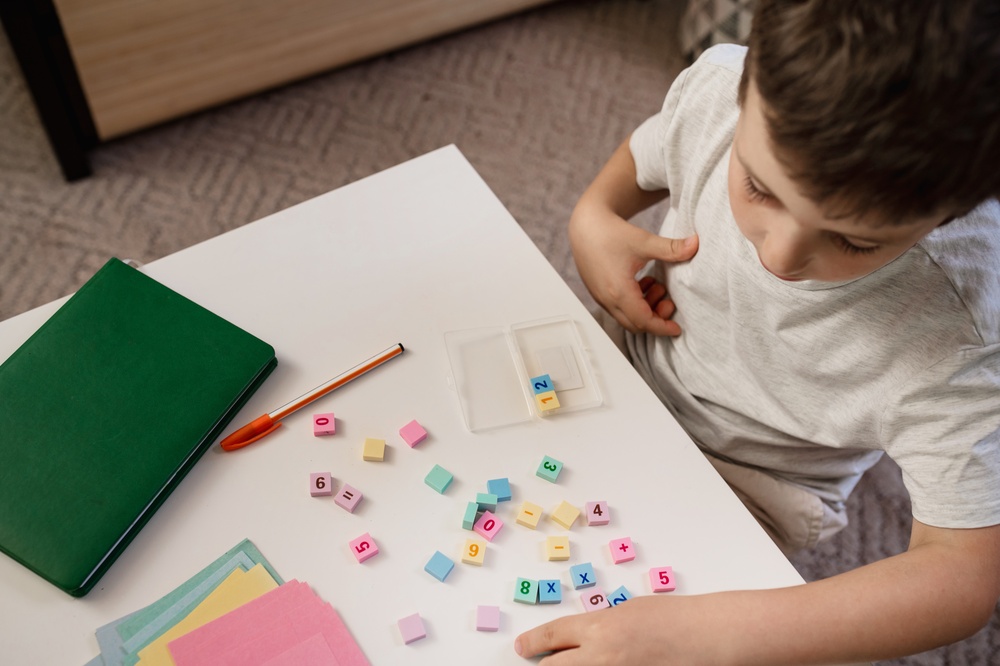
The best math manipulatives for homeschool use don't need to fill a cupboard. A small collection of base-ten blocks, Cuisenaire rods, fraction tiles and two-colour counters covers plenty of ground. Add a rekenrek or ten-frames for early number sense, then bring in geometry tools as needed. Giant mega-kits and laminated charts you could print are usually worth skipping.
This guide brings together advice from Every Homeschool, Outschool, Oxford Owl, Math-U-See and Amazon UK listings. All ages are taken from maker or listing pages.
Quick picks
- Best starter set (place value): Learning Resources Brights! Base Ten Starter Set
- Best all-rounder across grades: Learning Resources Cuisenaire Rods
- Best for fractions: Rainbow Fraction Tiles with Tray
- Best early number sense: 2-Row Rekenrek, Rainbow Ten-Frames and two-colour counters
- Best geometry: Pattern Block Activity Set and a transparent geoboard
- Best UK early-years system: Numicon (UK)
- Best combined kit: Learning Resources Take Manipulatives, Ages 8 to 10
- Skip: giant mega-kits you will not use, and laminated charts you can print
We may earn a commission if you buy through links on this page. It never changes our verdicts. How we review.
Learning Resources Cuisenaire Rods Wooden Introductory Set
Learning Resources Rainbow Fraction Tiles with Tray
Topic and age to tool: chooser
| Topic | US grade (UK year) | Tool | Age on maker or listing title | Buy or make? | Curriculum that names it |
|---|---|---|---|---|---|
| Counting to 10 | Pre-K to K (Reception to Year 1) | Numicon Shapes, ten-frames | Numicon First Steps 3+; ten-frames 5+ | Buy Numicon; print ten-frames | Numicon (Oxford) |
| Counting and number bonds to 20 | K to 1st (Years 1 to 2) | Rekenrek, two-colour counters | 5+ | Buy | Not checked |
| Place value | 1st to 4th (Years 2 to 5) | Base-ten blocks | 6+ (Brights) | Buy | Math-U-See uses its own Integer Block Kit |
| Operations and number relationships | K to 5th (Years 1 to 6) | Cuisenaire rods | 5+ | Buy | Not checked |
| Fractions | 2nd to 5th (Years 3 to 6) | Fraction tiles or fraction tower | 6+ | Buy tiles; paper strips work to start | Not checked |
| Geometry and shape | K to 5th (Years 1 to 6) | Pattern blocks, geoboard | 4+ and 5+ | Buy | Not checked |
| Time and money | K to 3rd (Years 1 to 4) | Practice clock, real coins | Varies | Make or use real items | Not checked |
US grade to UK year is a rough guide (UK Year = US grade plus one). "Not checked" means we did not confirm a curriculum publisher names that tool on its own site.
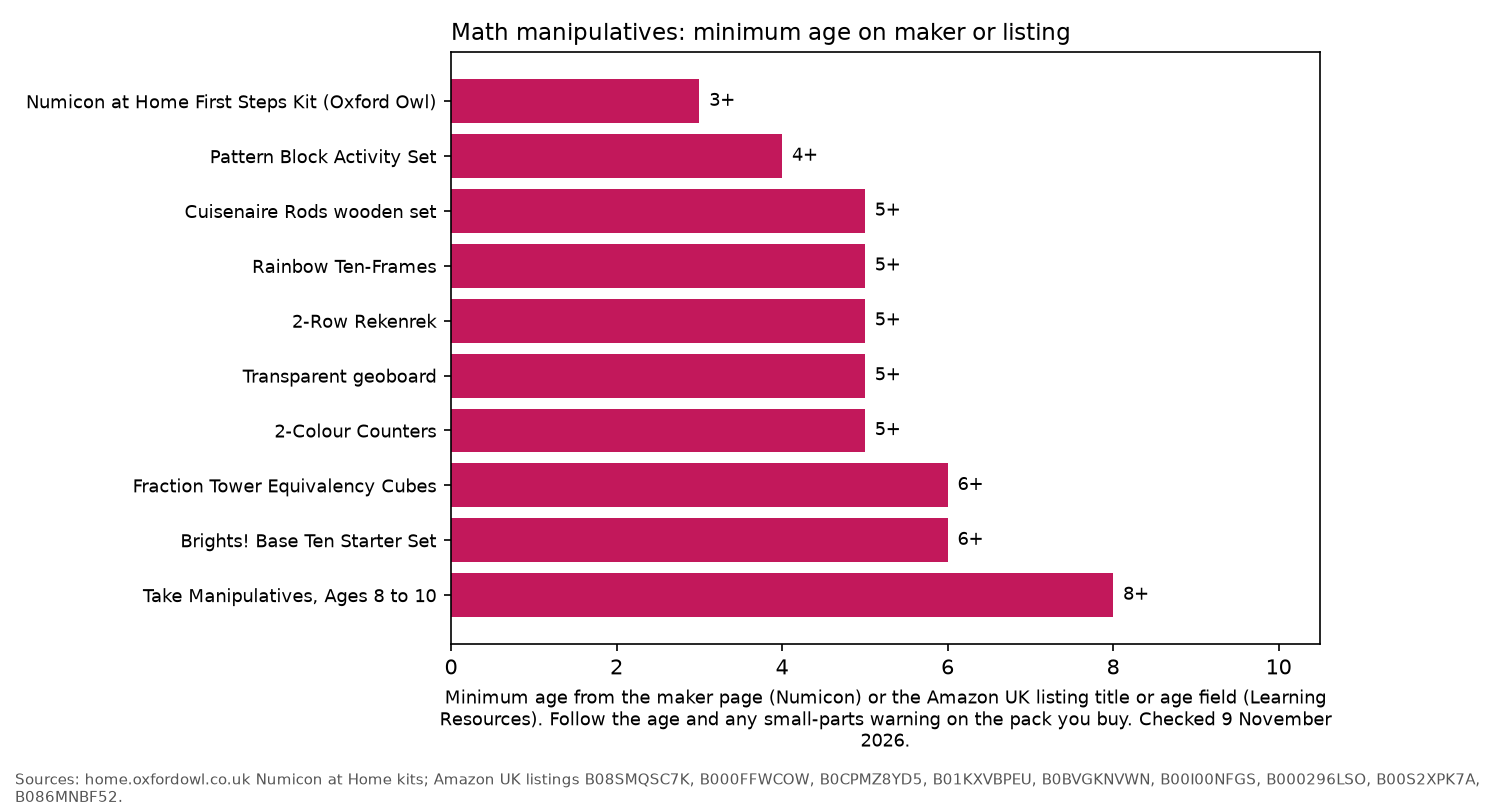
Always check the age printed on the pack you buy. Follow any small-parts warnings from the maker, as many counters and cubes are small.
The tools
Base-ten blocks: best starter for place value
Outschool calls base-ten blocks "the gold standard for place value". With units, rods, flats and cubes, a child can physically trade 10 ones for 1 ten.
The Brights! starter set listing includes 100 units, 30 rods, 10 flats, one cube and a 107-page book. It's listed for ages 6 to 10.
Who it's for: children learning place value and regrouping from about 1st grade (Year 2). Who it isn't for: pre-schoolers, who are better off starting with counters.
Watch out: the Brights listing has no featured offer, so this page does not link to it. The Base Ten Blocks Activity Set is sometimes sold by third-party sellers; check the seller and delivery at checkout.
Learning Resources Base Ten Blocks Activity Set
Cuisenaire rods: best all-rounder across grades
Cuisenaire rods come in ten different lengths, each with its own colour. With no numbers printed on them, children can explore how numbers relate to one another. Every Homeschool includes them among the four tools it says "cover most of K-6". For help choosing a set and getting started, see Cuisenaire rods at home below.
Who it's for: families who want one tool that takes children from addition through to fractions. Who it isn't for: anyone looking for a scripted programme straight out of the box.
Fraction tiles and fraction tower: best for fractions
Outschool says a child who holds a fraction tile and sees that two-fourths is the same size as one-half learns something different from a worksheet.
The Rainbow Fraction Tiles with Tray listing gives an age range of 6 to 12. Fraction Tower Equivalency Cubes come as a 51-piece set and are titled Ages 6+.
Who it's for: children in 2nd to 5th grade (Years 3 to 6). Who it isn't for: children still working on early counting.
Make at home: fold paper strips into halves, quarters and eighths. It's a free way to get started.
Learning Resources Rainbow Fraction Tiles with Tray
Learning Resources Fraction Tower Equivalency Cubes
Rekenrek, ten-frames and counters: best early number sense
A rekenrek is a bead frame with two rows, arranged in groups of five. It helps children recognise numbers in smaller groups, such as seeing 7 as 5 and 2.
The Learning Resources 2-Row Rekenrek, Rainbow Ten-Frames classroom set and 2-Colour Counters (120) are all titled Ages 5+.
Who it's for: children in K to 1st grade (Years 1 to 2). Who it isn't for: older children who have already moved beyond number bonds.
Make at home: ten-frames are easy to print on paper. Counters are easier to buy than make.
Watch out: the rekenrek is sometimes sold by third-party sellers; check the seller and delivery at checkout.
Learning Resources 2-Row Rekenrek
Learning Resources Rainbow Ten-Frames
Learning Resources 2-Colour Counters (120)
Pattern blocks and geoboard: best for geometry
Pattern blocks make shapes and their relationships easier to see. Outschool notes that they "naturally teach fractional relationships". For example, a trapezoid is half a hexagon, while a triangle is a sixth.
It describes geoboards as a way to explore area, perimeter, angles and symmetry.
The Pattern Block Activity Set is titled Ages 4+. The transparent geoboard, with 11 x 11 pins and 25 bands, is titled Ages 5+.
Who it's for: shape work from K upwards. Who it isn't for: children who still put small pieces in their mouths.
Learning Resources Pattern Block Activity Set
Learning Resources Transparent Geoboard
Take Manipulatives, Ages 8 to 10: best combined kit
For families wanting several tools together, the listing describes a home maths kit containing base-ten blocks, snap cubes, colour tiles and angle circles.
It's aimed at Years 5 and 6, with a listed age range of 8 to 12. It is sometimes sold via Amazon Global Store; check the seller and delivery at checkout.
The Ages 5 to 7 version had a listed dispatch time of 6 to 7 months, so it wasn't included.
Who it's for: older children starting a new curriculum. Who it isn't for: families who already have base-ten blocks.
Learning Resources Take Manipulatives Ages 8-10
Cuisenaire rods at home: which set and how to start
Cuisenaire rods for homeschool can be used for everything from early addition to fractions. They're reusable, too, so one well-chosen set goes a long way.
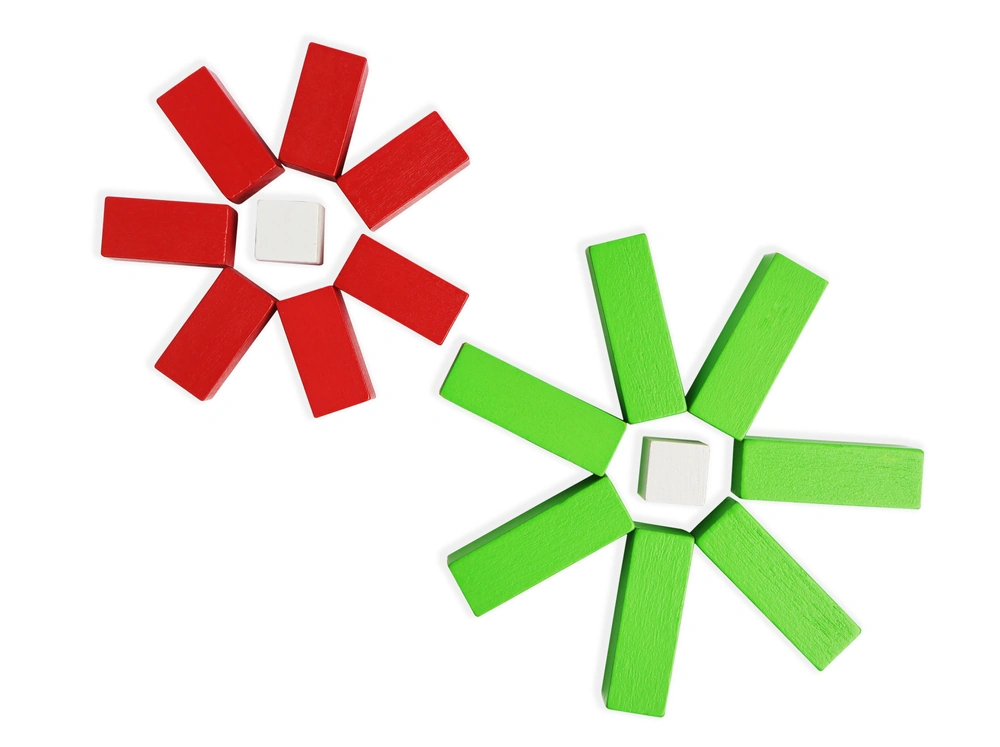
Maths Manipulatives describes ten rod lengths, ranging from 1 cm to 10 cm: white 1, red 2, light green 3, purple 4, yellow 5, dark green 6, black 7, brown 8, blue 9 and orange 10.
Maths Manipulatives adds that the colours link in families. Red, purple and brown are multiples of 2; light green, dark green and blue are multiples of 3; and yellow and orange are multiples of 5. It says the properties are the same whether the rods are wooden or plastic.
Wooden, plastic or connecting
There is no source comparing the materials, so the choice here comes down to editorial judgement. Wooden and plain plastic rods both work well for laying different lengths side by side, which is how most activities begin.
The plastic introductory set is listed as interlocking and suited to building.
Here's what each Amazon UK listing includes:
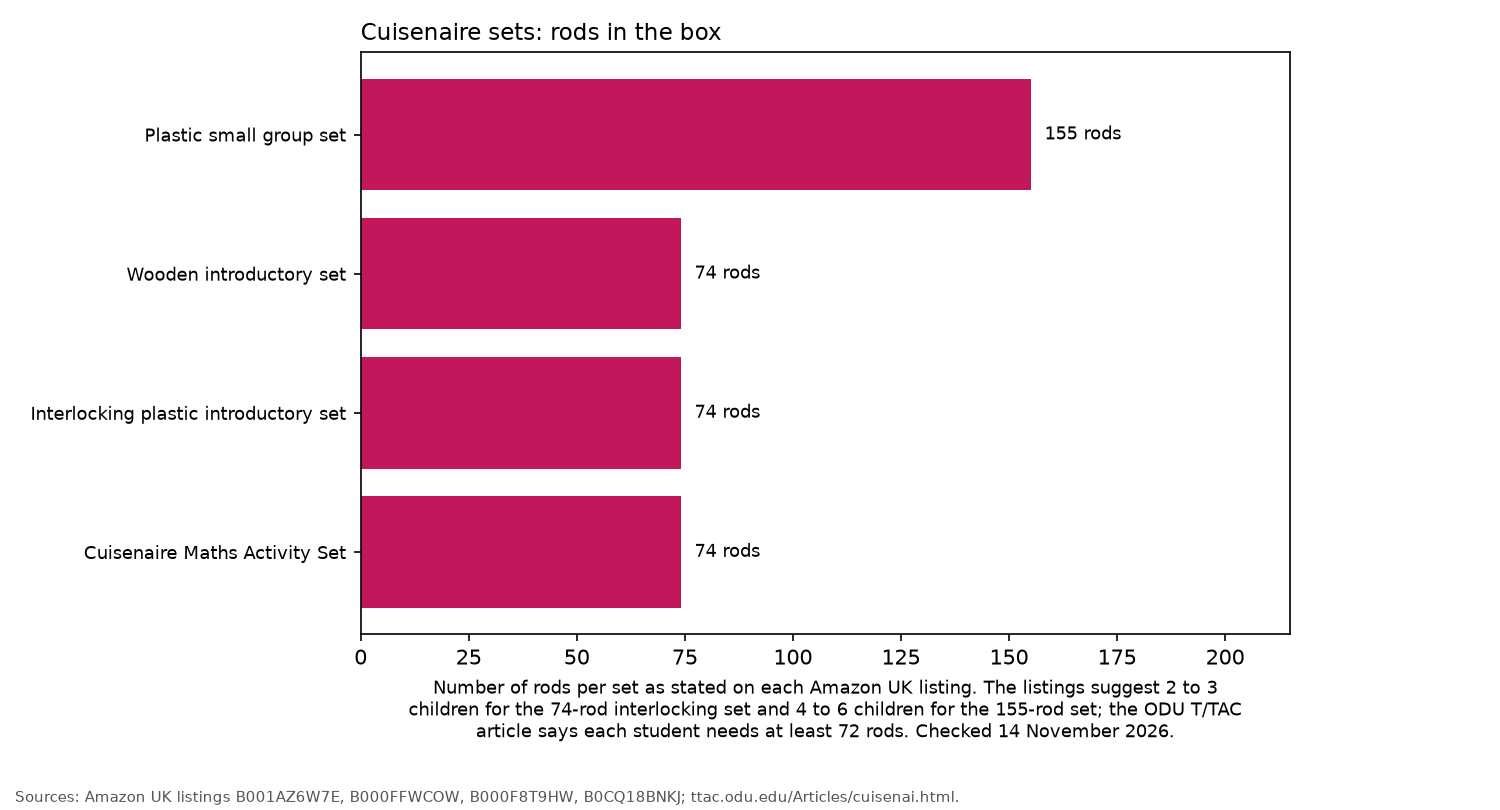
- The wooden introductory set contains 74 rods, a storage tray and a teacher's guide. It's listed for ages 4 to 8.
- The interlocking plastic introductory set contains 74 rods, a tray and a teacher's guide. It's listed for 2 to 3 children.
- The small group set contains 155 plastic rods, a tray and a teacher's guide. It's listed for 4 to 6 children.
- The Cuisenaire Maths Activity Set contains 74 plastic rods, 15 write-on cards and a guide, with 30 engaging activities aimed at Key Stage 1. It's listed for ages 5 to 9.
How many rods you need
The Old Dominion University T/TAC article by Carolyn True Ito says each student needs at least 72 rods. That means 20 white, 12 red, 9 light green, 6 purple, 5 yellow, 4 dark green and 4 each of black, brown, blue and orange.
A 74-rod set is therefore enough for one child. If siblings will be working side by side, the 155-rod set is a better choice, even though the 74-rod listings say they're suitable for 2 to 3 children.
Set chooser
| Household | Set to look at | Good for | Less good for | Companion | Source |
|---|---|---|---|---|---|
| One child aged 5 to 7 | Wooden introductory set, 74 rods | Staircases, trains and early addition | Several children at once | Teacher's guide in the box | Amazon UK listing; ODU T/TAC (72 rods minimum per student) |
| One child, wants building play | Interlocking plastic set, 74 rods | Free building alongside the maths | Plain length matching | Teacher's guide in the box | Amazon UK listing |
| Siblings together | Small group set, 155 plastic rods | Two or three children working at once | A single child on a small table | Teacher's guide in the box | Amazon UK listing |
| Wants guided activities | Cuisenaire Maths Activity Set | A scripted start from 30 Key Stage 1 activities | Large groups | 15 write-on cards and a guide | Amazon UK listing |
| Older child on fractions | Any set, 74 or more | Giving a rod a new value, such as calling orange "one" | Place value drills | Fraction tiles above | Maths Manipulatives |
Learning Resources Cuisenaire Rods Wooden Introductory Set
Learning Resources Interlocking Plastic Cuisenaire Rods Introductory Set
Learning Resources Cuisenaire Rods Small Group Set (155)
Learning Resources Cuisenaire Maths Activity Set
Your first five activities
The Old Dominion article recommends allowing a week or more for children to play with the rods and get familiar with them. Once they've had time to explore, try these five activities.
- Staircase. Arrange one rod of each colour in order, starting with the smallest and building up to the largest. Then work back down again.
- Free build. Let children make forts, houses and other objects, as suggested in the same article.
- Trains for number bonds. Build different trains that match the length of the orange rod. Take one car away and ask which is missing. The article recommends this for practising pairs of numbers that make ten.
- Rod trading to ten. Roll two dice and collect that many rods. Each time the total reaches ten, swap them for an orange rod. According to the article, the first child to collect ten orange rods, or 100, wins.
- "Call orange one." For fractions and decimals, Maths Manipulatives suggests assigning a different value to a rod. Call the orange rod one, then ask children to work out what the other rods are worth.
When trading to ten starts to feel easy, base-ten blocks help extend the same idea into hundreds.
For more practical maths options, see the best home education curriculum UK guide. The educational board games guide also covers games that help children practise the same number facts.
UK block: Numicon and Learning Resources UK (UK only)
Oxford Owl describes Numicon as "used in schools everywhere" in the UK. Its shapes have holes representing numbers from 1 to 10, helping children see ideas such as "one more" and "one less".
The Numicon at Home First Steps Kit is labelled Age 3+ and is intended for Foundation Stage and early Key Stage 1. It contains 32 shapes, 52 pegs, a baseboard and an activity book.
There was no Amazon UK listing for the full kit on 9 November 2026. Oxford University Press's box of Numicon Shapes 1 to 10 is available on Amazon UK, although the listing doesn't give an age.
Numicon Box of Shapes 1-10 (Oxford University Press)
Learning Resources also sells the Cuisenaire activity set and other maths kits through its UK website. The site blocked the automated check, so the product details above are taken from Amazon UK listings.
What curricula say
Math-U-See sells its own Integer Block Kit to go with its programme. Families following that curriculum will usually want the dedicated kit rather than generic base-ten blocks.
We could not confirm which tools other curricula name, so check your curriculum's own materials list before buying.
Storage
Keep each tool in its own lidded box so pieces don't get mixed up or lost. For help working out when to cover each topic, see the homeschool planners guide.
FAQ
What math manipulatives does every homeschool need?
Every Homeschool recommends base-ten blocks, two-colour counters, fraction tiles and Cuisenaire rods as a core collection that covers most of K-6.
Which manipulatives for kindergarten vs 3rd grade?
For kindergarten, start with counters, ten-frames, a rekenrek and pattern blocks. For 3rd grade, use base-ten blocks, fraction tiles and Cuisenaire rods.
Are Cuisenaire rods worth it?
Yes, particularly if you want one tool that covers several maths topics. The set chooser above can help you find the right size.
Wooden or plastic Cuisenaire rods?
Maths Manipulatives says both materials have the same properties. There's no source comparing the two, so focus on the set size and whether you prefer interlocking rods.
How many Cuisenaire rods do I need?
The Old Dominion University article recommends at least 72 rods per student. A 74-rod set is enough for one child. For siblings working together, the 155-rod set is listed for 4 to 6 children.
Cuisenaire rods or Numicon?
Oxford Owl describes Numicon as shapes with holes that represent numbers from 1 to 10. They're used in schools across the UK.
Cuisenaire rods represent numbers through length and colour instead, without printed numerals. The UK block above has more on Numicon.
What age are Cuisenaire rods for?
The wooden introductory set is titled Age 5+ and listed for ages 4 to 8. The Activity Set is listed for ages 5 to 9. Check the recommended age on the packaging before buying.
Base-ten blocks or place value discs?
Outschool includes both. Base-ten blocks show the physical size of each place, while place value discs use printed labels such as 1, 10 and 100.
Is Numicon good for home use?
Yes. Oxford makes Numicon at Home kits for this, labelled Age 3+.
What can I make at home instead of buying?
Paper fraction strips, printed ten-frames and number lines.
More from In the Trenches of Motherhood: Homeschool · Kids · Educational board games · Science kits by age · Educational Christmas gifts · About